Preserving ethnic soul through traditional costumes

ĐBP - Along with language and writing, traditional costumes are a unique cultural feature of the Khơ Mú people. Their multi-colored outfits reflect the diligence, creativity, and meticulousness of Khơ Mú women in every stitch, helping to pass on to the next generation a sense of pride and respect for their cultural roots.

Meticulous and creative in every stitch

In Điện Biên province, the Khơ Mú live in many areas, concentrated in communes such as Tủa Chùa, Quài Tở, Mường Mùn, Mường Chà, Mường Pồn, Phình Giàng, and Mường Nhà. Traditionally, the Khơ Mú did not weave their own fabric but used textiles woven by other ethnic groups to make clothing. Cultural exchange has given Khơ Mú costumes similarities with those of the Thái and Lào, but they still retain distinct identity through delicate techniques of measuring, cutting, sewing, patching, and embroidery.

Artisan Lò Thị Dậu from Huổi Lốt village, Mường Mùn commune, shared: “Our tailoring skills are passed down through experience. At first, people cut fabric directly on the body or from existing clothes. Later, when skilled, they could measure and cut without a sample.”

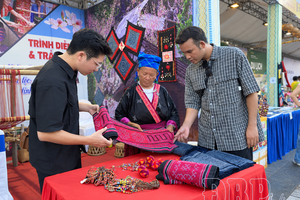
A Khơ Mú artisan introduces traditional costumes.

To complete an outfit, Khơ Mú women hand-sew meticulously using traditional techniques: overcast stitches for softness, running stitches for durability. With only fabric, needle, and thread, they create artistic, identity-rich clothing. A standout technique is patching and piecing brightly colored fabrics to form motifs such as diamonds, peacocks, flowers, and leaves, set against indigo cloth. Embroidery, often with motifs linked to mountains and forests, reflects beliefs and customs, passed down from generation to generation.

For Khơ Mú women, the traditional long skirt is the highlight. Made of cotton dyed indigo, it is plain yet elegant, tied to labor and daily life. The hem is embroidered with colorful motifs symbolizing wishes for prosperity and fertility. A bright blue waistband, 2-2.5m long, completes the outfit, both practical and graceful. The traditional headscarf (hưng pông chưm cưn), about 1.5m long and 30-40cm wide, is carefully embroidered, carrying cultural and aesthetic meaning.

Though modern clothing is often used for work, Khơ Mú people in Điện Biên still keep at least one set of traditional clothes to wear on important occasions. “Whenever we wear our traditional skirts and blouses for festivals or family events, we feel not only more beautiful and confident but also proud of our ethnic culture,” said Lò Thị Khiên of Huổi Lốt village.

Efforts in preservation

Today, the craft of making traditional Khơ Mú costumes is fading, remembered only by some elders. Few families retain traditional-style outfits, and many use industrial fabrics with pre-made patterns instead of handmade embroidery.

To preserve and promote this heritage, the provincial museum partnered with Mường Mùn commune and artisans to open training classes for learners aged 15-50. Under the guidance of skilled artisans, trainees learned every step of making traditional attire. This not only built practical skills but also instilled cultural pride in the younger generation.

Over the course, learners produced 15 complete sets with 54 items. After assessment, 18 pieces were handed to the commune for display and cultural use, while 36 were kept by the museum for research and preservation.

Beyond training, efforts focused on encouraging artisans and learners to become core forces in preservation, passing skills to younger generations. “For the first time, I learned the full process, from measuring and cutting to sewing and embroidery. At first, it was difficult, but with the artisans’ guidance, I managed to make products on my own. I feel proud to help keep and spread Khơ Mú culture and want to teach my children in the future,” shared trainee Lò Thị Mai.

The effort to preserve and teach traditional costume-making not only helps maintain Khơ Mú identity but also fosters pride and responsibility within the community. Each stitch connects past with present and embodies the hope that Khơ Mú culture will continue to shine within the diverse cultural tapestry of Điện Biên’s ethnic groups.

Sầm Phúc
Comment

You have 500/500 characters left

Please enter 5 or more characters!!!

Recent news

  • 'Crop restructuring drives sustainable agriculture in Điện Biên

    Crop restructuring drives sustainable agriculture in Điện Biên

    ECONOMY -
    ĐBP - Điện Biên province is restructuring its crop mix, identifying the expansion of coffee, macadamia and fruit trees as the backbone of a green, sustainable agricultural development strategy. This orientation is set out in the provincial Party Executive Committee’s Resolution on restructuring the agricultural sector toward concentrated, green, smart and sustainable commodity production for the 2026-2030 period, with a vision to 2035.
  • 'Expanding market for local agricultural products

    Expanding market for local agricultural products

    ECONOMY -
    ĐBP - In Điện Biên province, in the context of agriculture shifting strongly from the mindset of “producing what we have” to “producing what the market needs,” bringing local agricultural products to become specialties and conquering larger markets is opening up a sustainable direction for farmers.
  • 'Unity dance by Đà River

    Unity dance by Đà River

    CULTURE - SPORTS -
    ĐBP - In the early days of 2026, when the morning mist still lingered on the water surface of the Sơn La Hydropower Reservoir, we were present in Mường Lay ward, Điện Biên province.
  • 'Well preparing for “Compassionate Tết” program

    Well preparing for “Compassionate Tết” program

    SOCIAL AFFAIRS -
    ĐBP - The “Compassionate Tết” program for the 2026 Lunar New Year (Tết) – the Year of the Horse is a humanitarian activity of deep significance, aiming to care for and support poor households and individuals in difficult circumstances in Điện Biên province, helping them have the conditions to enjoy spring and welcome Tết.
  • 'Điện Biên builds concentrated raw material areas

    Điện Biên builds concentrated raw material areas

    ECONOMY -
    ĐBP - In highland communes of Điện Biên province, agricultural production was previously mainly small-scale and fragmented by household. This led to difficulties in scaling up and organizing consumption according to the value chain.
  • 'Bringing digital government closer to people in Điện Biên

    Bringing digital government closer to people in Điện Biên

    SOCIAL AFFAIRS -
    ĐBP - From installing the VNeID app to completing administrative procedures on smartphones, the “Digital literacy for all” movement is steadily bringing digital government closer to the people of Điện Biên. Beyond making public services more accessible, the initiative is playing a key role in accelerating administrative reform and building a modern, efficient grassroots administration.
  • 'How Điện Biên needy people escape poverty

    How Điện Biên needy people escape poverty

    ECONOMY -
    ĐBP - Once poor and near-poor households with difficult lives, thanks to timely access to support programs and projects of the Party, the State, and social organizations along with suitable livelihood models, many families in highland communes have gradually stabilized their lives.
  • 'Accompanying taxpayers

    Accompanying taxpayers

    ECONOMY -
    ĐBP - The transition from flat tax to declaration-based tax starting in 2026 is assessed as a step suitable for modernization, transparency, and integration goals, but business households must adapt to a model completely different from long-standing habits.
  • 'Opening tourism opportunities for Điện Biên

    Opening tourism opportunities for Điện Biên

    TRAVEL -
    ĐBP - The completion of the Điện Biên Airport upgrade and its reopening in December 2023 has ushered in a new phase for transport infrastructure, laying a vital foundation for Điện Biên to gradually remove connectivity bottlenecks, expand its development space, and enhance its capacity to attract investment and tourism.
  • 'Proactive on-site fire prevention and fire fighting

    Proactive on-site fire prevention and fire fighting

    SOCIAL AFFAIRS -
    ĐBP - Whenever a fire or explosion occurs, no matter how professional the firefighting force is or how sensitive the response is, property damage is unavoidable. Therefore, for fire and explosion prevention and fighting, besides the responsibility of functional forces, the top important factor is strengthening proactiveness and timely rescue of on-site forces.
  • 'Solid foundation promotes sustainable tourism development in Điện Biên

    Solid foundation promotes sustainable tourism development in Điện Biên

    TRAVEL -
    ĐBP - After 5 years of implementing Resolution No.03-NQ/TU, dated May 7, 2021, of the Executive Board of the Điện Biên provincial Party Committee regarding Tourism Development until 2025, with orientation to 2030; based on available advantages, many potentials have been step-by-step awakened and effectively promoted.
  • 'Steel shield at Northwestern peak

    Steel shield at Northwestern peak

    SOCIAL AFFAIRS -
    ĐBP - 143 collectives and 775 individuals were honored with noble awards from the Party, the State, and the Ministry of Public Security. With sweat soaking the forest paths, with steel will amidst myriad dangers, the Điện Biên provincial Police force has built a fortress of peace at the peak of the Northwest sky, where every soldier is a fulcrum of trust for the people.